




Language Delay
Speech-language therapy is a specialized field dedicated to enhancing communication and social interaction.
We support individuals in overcoming daily challenges, building the confidence and skills needed to thrive in social, academic, and professional environments.
💡 Type
1. Language Development Disorders
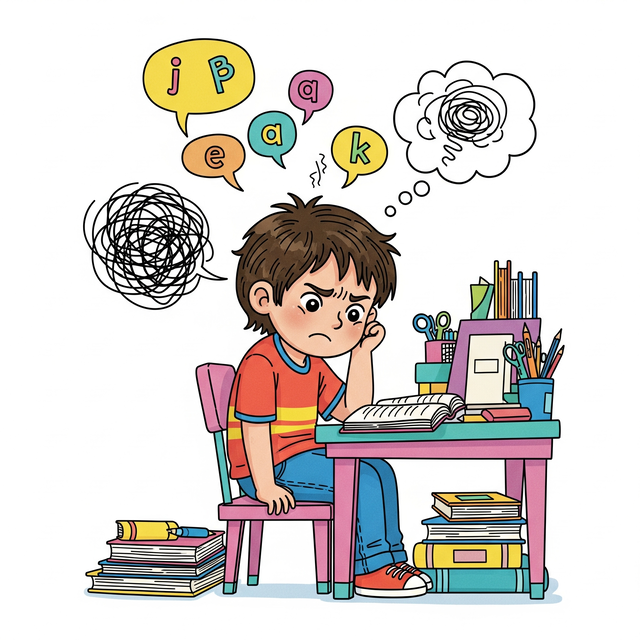
Language Development Disorders
A significant delay in a child’s ability to understand or use language compared to their peers.
Core Challenges
Semantics : Difficulty understanding or using word meanings.
Syntax & Morphology : Struggles with grammar and sentence structure.
Pragmatics : Challenges in social communication and conversation rules.
Phonology : Issues with speech sounds and patterns.
Specific Language Disorder
A language delay in children who are otherwise developing normally. It is diagnosed when struggles persist despite having
Normal Hearing : No hearing loss or auditory issues.
Typical Intelligence : Cognitive and IQ levels are within the normal range.
Healthy Neurology : No brain or motor nerve damage.
Emotional Stability : No underlying psychological or emotional factors.
Reading Disorder
Reading Disorder, commonly known as Dyslexia, occurs when reading performance is significantly below the expected level for a child’s age and intelligence.
This persists even with typical intelligence, adequate education, and normal sensory function.
2. Speech and voice disorders
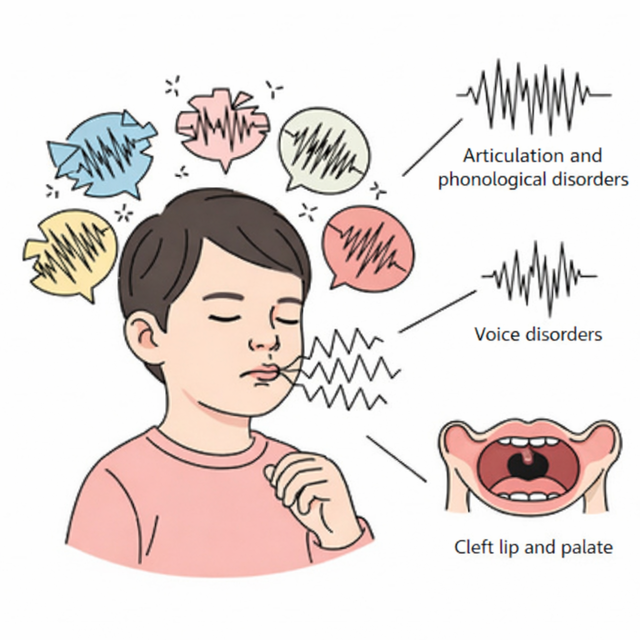
Articulation and phonological disorders
ssues with the quality, pitch, or loudness of a person’s voice.
Common Signs
Pitch : Voice is too high or too low for their age.
Volume : Difficulty staying at an appropriate loudness.
Quality : Voice sounds hoarse, breathy, or strained.
Fatigue : Voice becomes weak or tired after speaking.
Voice disorders
When inaccurate pronunciation makes it difficult for others to understand a child's speech.
Common Signs
Intelligibility : Hard to understand in daily conversations.
Production : Difficulty making specific speech sounds.
Substitution : Replacing sounds (e.g., "tat" for "cat").
Cleft lip and palate
A condition where structural differences in the lip or the roof of the mouth (palate) affect speech development.
How it affects communication
Articulation Errors : Difficulty producing specific speech sounds.
Hypernasality : A "nasal" sounding voice caused by air escaping through the nose.
Language Delays : Potential challenges in overall language acquisition.
3. Language disorders caused by other specific factors
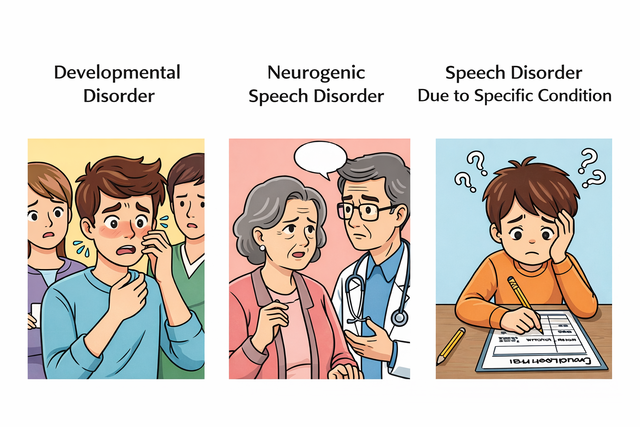
Fluency Disorders
A Fluency Disorder affects the natural flow, rhythm, and speed of speech.
Common signs to look for
Repetitions : Repeating sounds or words (e.g., "b-b-ball").
Blocks & Prolongations : Struggling to get a word out or stretching sounds.
Awkward Pace : Speaking too fast or with an uneven rhythm.
Physical Tension : Eye blinking or facial tension while trying to speak.
Neurogenic Language Disorders
A language disorder caused by damage to the brain’s communication centers, often due to a stroke or a traumatic accident.
Key Example: Aphasia
Cause : Brain injury from trauma, stroke, or other medical conditions.
Challenges : Difficulty speaking, understanding, reading, or writing.
Recovery : Specialized therapy to help the brain relearn and restore communication skills.
Language Disorders Caused by Specific Disabilities
Language Disorders Related to Other Conditions
Communication challenges resulting from specific developmental or neurological conditions.
Related Conditions
Developmental : Intellectual Disability, Autism Spectrum (Asperger’s), and ADHD.
Sensory & Emotional : Hearing Impairment and Developmental Attachment Disorder.
Common Challenges : Difficulty with social interaction, understanding instructions, or expressing needs.